
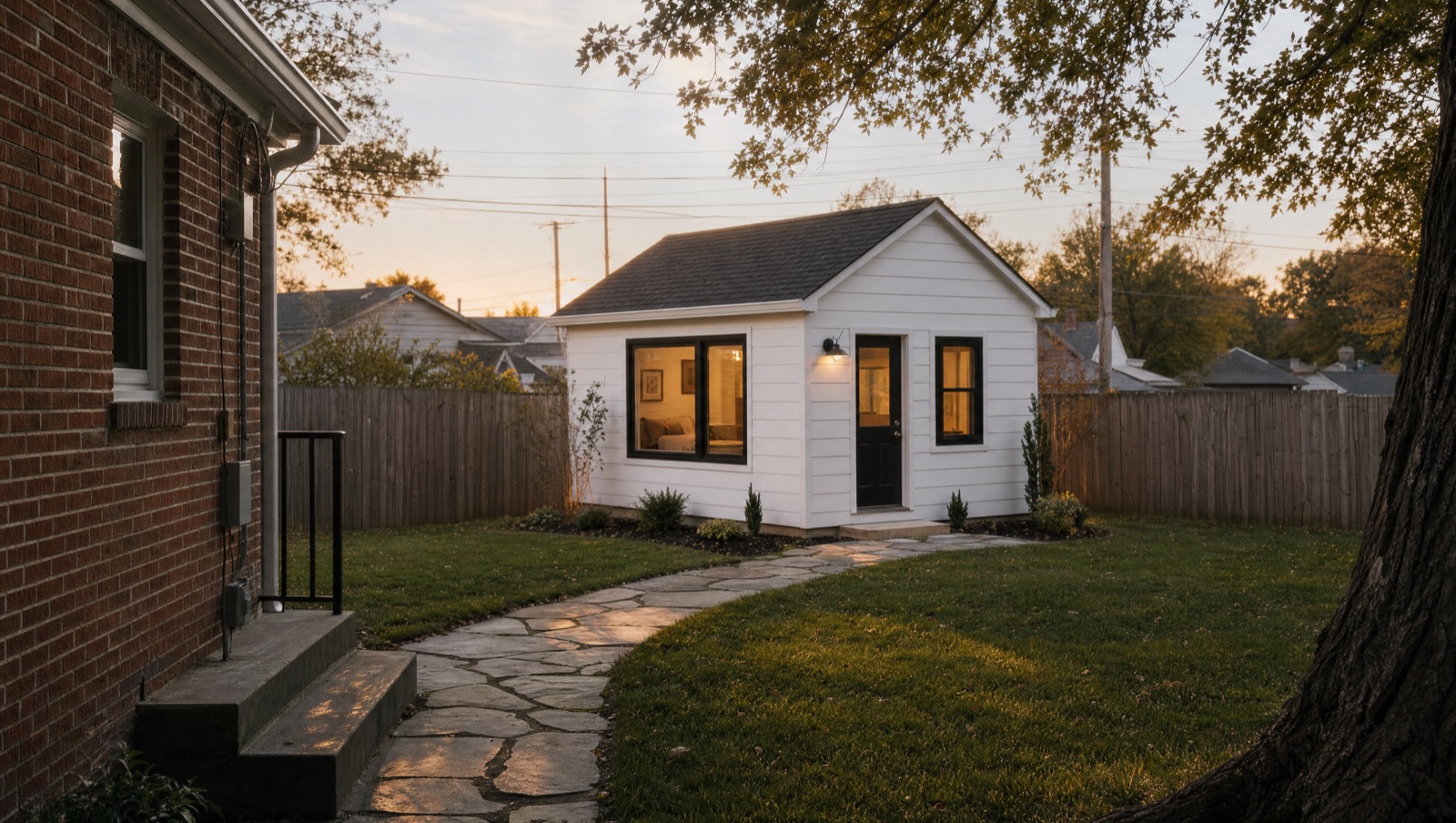
Kansas City, Missouri is the one city in the metro where an accessory dwelling unit is allowed by right, citywide, on any lot with a house. The ordinance is short and specific, and the numbers in it decide what you can build. Here they are, with a worked example.
Where ADUs are allowed
Ordinance 220698, passed September 15, 2022, added Section 88-305-15 to the zoning code. It permits an accessory dwelling unit on any lot with a detached dwelling where that dwelling is the principal building. There is no public hearing and no special use permit; it is a standard building permit through City Planning and Development, plus the trade permits.
The unit can be attached to the house or detached. Attached units go in the rear or side yard. Detached units go in the rear yard, and a detached unit may share a building with a garage.
The size rules
For a detached ADU, three caps apply at once, and the smallest one wins:
- Floor area: 800 square feet or 90 percent of the house’s floor area, whichever is smaller.
- Footprint: 60 percent of the house’s footprint or 25 percent of the rear yard, whichever is smaller, and never more than 800 square feet.
- Height: no taller than the house, and never over 25 feet.
A worked example
Say your house is a 1,400-square-foot ranch on a single level, so its footprint is also about 1,400 square feet, and the rear yard is 2,400 square feet.
- 60 percent of the house footprint: 840. 25 percent of the rear yard: 600. The smaller number wins, so the ADU’s footprint is capped at 600 square feet.
- Floor area is capped at 800 or 90 percent of 1,400 (1,260), so 800.
- Result: a single-level 600-square-foot cottage, or a two-level unit on a smaller footprint that totals up to 800 square feet of floor area.
On a bungalow lot with a small rear yard, the 25-percent rule is usually the one that bites. That is why an ADU above a garage is so common in Kansas City: the garage footprint is already there, and the living space goes up instead of out.
Setbacks and placement
A detached ADU sits 5 feet from all property lines, including projections like eaves. On a street-side yard it is 5 feet or the same setback as the house, whichever is greater. Everything else follows the normal accessory structure rules. Exterior stairs to an upper-level unit are allowed only on the sides of the building that face the interior of the lot, never the street or a neighbor’s line.
Parking
None required. The ordinance says no additional off-street parking is needed for the ADU. If you add parking anyway, it has to meet the normal parking standards.
The owner-occupancy catch
The owner of the lot has to live in either the house or the ADU, and that gets recorded against the property as a deed restriction. Proof of the recording goes to the city before the certificate of occupancy is issued. The ordinance directed the city manager to report back on this requirement after one year; as of September 2026 we cannot find an amendment removing it, so plan on it. It matters for resale and financing, and it means a pure investor play with both units rented does not work in Kansas City today.
Free pre-approved plans
The city publishes pre-approved housing master plans at no cost, and the set includes an ADU-over-garage design. Using a pre-approved plan can shorten plan review. It does not remove the trade permits or the site-specific review of setbacks and footprint.
And the shed rule, while you are here
If the project is storage rather than living space, Kansas City does not require a building permit for a one-story detached shed, garage, or carport with a projected roof area of 200 square feet or less. Over 200, you need a permit, and the city’s Code Questions page notes a Board of Zoning Adjustment step for sheds, storage buildings, and pool houses over that size.
What we do
KC Structure Co builds detached ADUs and garage-with-unit-above buildings across Kansas City from our Lee’s Summit shop. We run the footprint math for your lot at the site visit, design to the 5-foot setbacks and the stair rule, and file the building and trade permits. See the Kansas City service area page for the rest of what we build there, or the ADU catalog for models and ballpark pricing.
Wondering how the suburbs compare? Olathe allows up to 1,000 square feet, Blue Springs has no ADU ordinance at all. We mapped every city in Where you can build an ADU in the Kansas City metro.
Sources: Ordinance 220698 (City of Kansas City, via the Mid-America Regional Council’s ADU ordinance collection); City of Kansas City, Building Permit Exempt Work. Verified September 2026.